Our weekly email news letter. Sign up here to get them delivered straight to your email in box. See below for previous issues...
Please note that product availability and prices may have changed from when this newsletter was sent. Please check this site or phone us for current availability and pricing.
Thursday 3rd December, 2015
Hi
We have been moving the hydrangeas and getting them all together under the shady area that we have in the nursery. It never ceases to amaze me how much variation there is in this group of plants that have taken the name of their own genus.
Hydrangeas are native to Southern and Eastern Asia and are predominantly shrubs, though some versions or species can actually form small trees. From my experience Hydrangeas mostly lose their leaves though there are some forms like the Dichroas that are considered evergreen.. 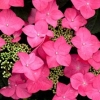
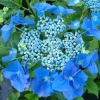
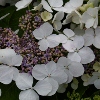
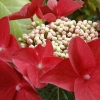
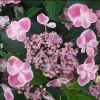

Macrophylla, one of the main species that we grow in our gardens, are native to Japan and have are a couple of flower types. We should all be familiar with the classic mop head hydrangea and then there are the lace caps that also very pretty. The inflorescence (a group or cluster of flowers) of a hydrangea macrophylla flower is called a Corymb which means many flowers on the same plane, but there are two distinct type of flowers , LOL those that get sex (fertile) and those that just look pretty(infertile). What we would consider to be the flower is actually four coloured sepals (these are usually green and support the flowers) and if you are like me, have to put your glasses on to see the actually flower bits. I imagine that the inside of the Lace cap hydrangea flower is full of fertile flowers without sepals and then has that outer ring of infertile but decorative sepals. Corymb Lace cap Sepals Flowers
Now Hydrangeas generally come in shades of pink, blue, purple and white but the important point to know about the colour of Hydrangeas is that they will be either pink or blue according to soil acidity. An acid soil will cause the flowers to be blue whereas an alkaline soil will cause the flowers to be pink shades. This is the bit I liked when I Googled Hydrangeas. "This is caused by a colour change of the flower pigments in the presence of aluminium ions which can be taken up into (and wait for it) Hyperaccumulating plants" (These are plants that grow in soils with very high metal levels)
Its quite fascinating really as I took some pics of the Hydrangea Nightingale that we had in the nursery and some were really pink others were really blue as this cultivar should be and then was one somewhere in between... I hadn't really appreciated how extreme the pink / blue thing could be. So if you want to make your hydrangea blue then apply aluminium sulphate or Lime to enhance the pink and red shades. Make sure to do this in the winter before the flowers have been initiated. If your pH level is the correct acidity then the plant can use the aluminium and produce the blue you are trying to achieve.
To prune or not to prune, well you have to know how old your wood is .....
I often get asked about pruning of the mop head hydrangeas and simply put if you prune at the wrong time then you will lose next season flowers. What you need to remember is that hydrangea macrophylla flower on old wood. Old wood are the stems that have been on the hydrangea since before the current season, so if you prune your hydrangea back in the winter then you need to ensure that you leave some of the older wood to flower next season. There are some excellent sites on the internet with pics or video's to show you how to get the best out of your hydrangeas.
Where to grow your hydrangeas
Hydrangeas like those dappled light spots in the garden but they don't like to dry out too much over the summer. I see many plant these under established trees which is all good but sometime these places can be too dry as the tree get the available soil moisture first. Good compost and regular water can help make these dry shady positions more suitable.
Hydrangeas are overall quite hardy and will grow most places but the flowers are quite sensitive to intense sunlight as this may cause the flowers to burn.
I have never cooked these types of seafood before but when our friend Jeannie stayed the other week she had all the ingredients prepped in readiness for dinner for when we got back from Harry's "Wellington flight that wasn't" the other week. I got to put all of it together under her instructions and it was dead easy and really delicious, so much so that we gave it another go last night for dinner. I think that she discovered the original recipe in a Dish magazine and then adapted it to her own version. I give it the thumbs up and so have included it in our receipes section on the webpage. What's cooking under Info tab in the seafood section or click on the title above to be taken there.
And on the note of Harry's flight that wasn't, it is going to be again this Friday but this time he is going via a bigger plane from the big smoke.
Pyrostegia venusta or Flame vine. We have never had these before as its a tad to cool grow them here in the Waikato unless you have one of those warmer microclimates down by the river or away from the frost. sometimes its just a matter of getting these high or established enough before the following winter. These are just magnificent though and as the name suggests very vibrant like a flame orange. It will cover itself in masses of stunning orange flowers. If you have seen this before you will definitely want one of these.
Iris Caesars Brother .... is the most stunning colour of deep dark purpley blue. these Siberian Irises have come up for a deal as they have finished flowering but are big clumps in the pots. Be great for a garden or pond Next week is the last week for Mail orders prior to Christmas so if you want something sent out then we will dispatch Tues and Wednesday. There will be no more mail order again until Tuesday 5th of January.
I know what I have to do over the next few weeks before Christmas and its going to be a busy fortnight. Have to get all the gardens weeded, hedges trimmed and everything spic and span so that it will stay tidy over the xmas period while the team all have a well deserved break. It will also mean that when we have our champagne breakky on Xmas day all our family and friends love to wander through the garden champers in hand of course and the garden will look awesome.
Cheers
Lloyd, Harry and the Wairere Team
Make it a Wairere weekend w
here even
GNOMES know that gardening's not a drag
Archived by year 2011 | 2012 | 2013 | 2014 | 2015 | 2016 | 2017 | 2018 | 2019 | 2020 | 2021 | 2022 | 2023 | 2024 | 2025 | 2026 |
2015 Newsletters...
We're back (8th January, 2015)
Settling In (29th January, 2015)
Summer colour (30th January, 2015)
Fabulous Feb (6th February, 2015)
Roses on sale (16th February, 2015)
stevia (20th February, 2015)
Cheeky Climbers (6th March, 2015)
Michelias and Camellias (11th March, 2015)
Living fences (20th March, 2015)
Easter is nearly here (25th March, 2015)
Mourning the end of summer? (2nd April, 2015)
SALE NOW ON!!! (8th April, 2015)
Autumn Harvest (17th April, 2015)
What to do with all those leaves. (22nd April, 2015)
Autumn Flowers (1st May, 2015)
Sunday Mothers Day (8th May, 2015)
Colours of Autumn (15th May, 2015)
Always a project (22nd May, 2015)
Rose potting (23rd May, 2015)
Clip n Snip (4th June, 2015)
Roses Galore (14th June, 2015)
Rose Climbers (19th June, 2015)
Its Time to prune (3rd July, 2015)
Like a candy shop (11th July, 2015)
The pruning session (16th July, 2015)
Red and white stems (24th July, 2015)
Rose pruning Thur and Fri (24th July, 2015)
Winter Colour (31st July, 2015)
Time to feed (9th August, 2015)
Magnolias (20th August, 2015)
Gardeners work is never done (25th August, 2015)
Till the cows come home, or get shoooood away! (28th August, 2015)
Topiary Art (11th September, 2015)
Tosca in spring (19th September, 2015)
An extra hour (25th September, 2015)
The first Friday in October (2nd October, 2015)
Pretties Galore (9th October, 2015)
Frantic Fridays (16th October, 2015)
geraniums are in (20th October, 2015)
November events (31st October, 2015)
Movember (9th November, 2015)
Christmas is coming (20th November, 2015)
Harry was blowing in the wind (26th November, 2015)
..... December
Chilli out for Christmas (18th December, 2015)