Friday 24th June, 2016
Hi
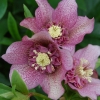
I never realised how promiscuous (with a little help) the hellebores are...
OMG all of a sudden we have a whole heap of new
winter roses in the nursery with the coolest leaves and well... very pretty flowers and I got curious as to what they are botanically.. You know how it is!!
Mostly you can guess at what species, usually by how the leaves look and officinalis is pretty easy with those lovely bright green leaves. Then there are the Corsicus, Sternii, niger and foetidus types which are all pretty distinctive but hey all along the same lines.
It was in doing this that I discovered some of these were Helleborus x ericsmithii and a crossed hybid that I hadn't heard of... just as well for my friend google in the early morn as I learnt about Eric Smith.
Eric Smith was a nurseyman in the UK who worked at some quite famous places like Hilliers, Plantsmen Nursery and Hadspen House. He apparently spent most of his life creating new forms of hostas, bergenias and yes hellebores which he did for the love of plants and not financial gain.... well so I read!
But the story starts before our man Mr smith, with a guy called Frederick Stern who, in the early 1950's, crossed Helleborus lividus with Helleborus argutifolius (Corsican Hellebore) to produce one called sternii.
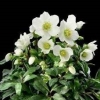
Eric Smith took Stern's plant and crossed it with the large, white flowers of the Christmas rose, Helleborus niger, to produce his own jewel of a plant, H. x
ericsmithii.
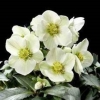
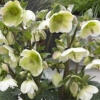
Smith's plant has sprays of large white flowers ( from H. niger) but are tinged with pink. On mature plants, the flowers will grow to 10 cm wide. The dusky pink stems are inherited from H. lividus. Rather than hiding among the foliage, the flower spikes grow to about 35 cm tall, a good 10cm-15cm above the leaves, and it is worth growing for its foliage alone. The slightly serrated leaves are dark green, overlaid by a pewter lustre with a feint white vein running through it. The silvery sheen is most pronounced on new growth.
H. x ericsmithii is sterile and can only be produced by making the original crosses or by dividing an established clump. Division is a slow and expensive process, while reproducing Smith and Stern's hybridisation can give inferior plants.
Thanks to modern technology, Smith's treasure is now propagated by tissue culture and is available to all gardeners around the world.
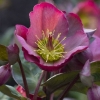
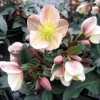
Hellebores orientalis and Hybridus - are good for almost anywhere. These are the plants that everyone grows, as they come in such a vast array of colour and in single, anemone-centred and double-flowered forms. They are best in good soil in partial or dappled shade, the less shade they have the more their soil needs to hold moisture. They also have a tendency to deliver self-sown seedlings in a wide range of colours and forms.
Hellborus nigercors are great for dry shaded areas. This cross of the shade-loving
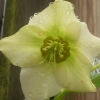
H. niger (the Christmas rose) and sun-loving H. argutifolius (the Corsican hellebore) created vigorous plants with bold evergreen foliage and usually white flowers that fade to green. It's one of the most vigorous and resilient of hellebores which copes well with dry shade, especially if watered and fed after planting to help it settle in. You could also use H. foetidus (stinking hellebore) in a dry shaded position. These are also very good for clay soils or crevices in stone walls.
Helleborus x sternii has a small compact habit which lends itself well to container growing. This variety features pewtery foliage veined in silver/white and green flowers flushed with pink carried on purple stems in late winter.
Helleborus ballardiae a cross of H. lividus and H. niger that produces blue green foliage that may be marbled or have a silver sheen over the leaves and usually produce pink flowers that fade to light in the centre. These are great for well drained positions.
Helleborus odorus is probably the most vigorus of the green flowered species which has a scented large flower and enjoys plenty of sunshine as long as it has nice moistness in the soil but not waterlogged.
Helleborus lividus (The Latin lividus refers to the colour of the leaves, literally "lead-grey".) Usually producing pink flowers backed with green and with green foliage veined with silver, this Majorcan plant flowers at the chilliest time of the year and originating from such a lovely warm place it can use some protection from the frosts that can be prevalent when it flowers.
I just love
hellebores when they are mass planted or naturalised in an area and they are pretty good at suppressing weeds once they cover all the space. A great tip for keeping these looking fabulous is to remove all of last years leaves at ground level, this probably should have been done by now though you may still have time. The idea is to let all the new flowers come through uninhibited by the leaves and then new seasons leaves will grow after the flowers. You plants will look stunning in bloom and will be refreshed with new foliage to last the whole year again.
Seedling hellebores. We have a good crop of
officinalis seedlings available now for $7.99 ea which will make mass planting more affordable to fill those shady places.
Hi! Cathie here. Lloyd had to go back to potting as there is still so much to be done. I have to say that while I am sitting here in my lovely warm dry office watching the team work so diligently in the rain and cold I thought how lucky am I that my computer skills are good enough to necessitate that I stay inside to work, guess I better do a good job of writing this so I get to stay warm and dry. LOL.
It was an amazing sight seeing the
container arrive and be
settled in place, I always find it fascinating to watch heavy machinery in operation. Then it was rather awe inspiring when the doors of the container were opened and all you all you can see is a huge volume of bare rooted sticks. (I'm quietly thinking are you sure you wanted me to order that many!) But as you can see by the pics posted on our fb page the team are getting through them, there is now space in the container for the whole coop , not
just the chooks. The nursery looks full to overflowing and every spare space is quickly being filled with the trees as they get potted. Lloyd was doing a superb job of filling the dirt hopper when Harry wasn't looking too. (
Evidenced here!)
Often Lloyd or Harry will make mention of the plants that particularly grab their attention. Whether it be because of their size, bushiness or generally good health and vigour in comparison to others we may have had, perhaps due to a rarity factor, or they are just simply exciting plants it all boils down to the fact that they stand out from the others in a good way. I thought I would mention a few of them.
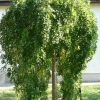
Weeping trees for form texture and colour.
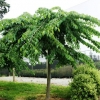
I have to put this at the top of the list as I have a beautiful specimen of it in pride of place in my garden and I just love it. I have always know it as a Japanese Kowhai and like all Kowhai it has pale yellow flowers, but these are small and produced in abundance when the conditions are right. It is a beautiful tree when in leaf, but in winter when it had been laid bare by the wind it has the most amazing branch structure that resembles arch upon arch upon arch. A tree with seasonal interest that is well worth a place in the garden. Deciduous
Laburnum alpinum pendula You may be familiar with
Laburnum watereri Vossi, often called the golden chain tree due to it's bright yellow flower racemes. Well this is the weeping form. This tree is just as stunning in flower with it's scented wisteria like flowers borne in spring but on a weeping tree. This tree is deciduous, frost hardy and adaptive to most soils. They like a sunny position in soil with good moisture retention. Deciduous
Ulmus Horizontalis otherwise known as the Horizontal Elm. This unique tree has a rigid horizontal habit to it's branches which give this tree amazing structural visual appeal. Superb as a specimen tree. Hardy, coastal tolerant and easy to grow. This one grows wider than it is tall making it an excellent shade tree. Deciduous
Michelia Uniquely Yours is a new release that we are happy to be able to offer. Beautifully fragrant pure white flowers are produced in mass in the spring, but before this throughout the winter, are the most gorgeous eye catching flower buds. It is expected that this will be a bushy prostrate shrub that can grow to 2m if left unpruned but pruned it can be as small as 60cm or less making it a great evergreen option for a ground cover. Make it Uniquely Yours!
Camarosa Strawberries It's the best time to plants these little stolons in your garden if you are wanting to get a crop of juicy ripe strawberries. I don't want anyone to miss out on these strawberry plants as often people leave it too late to put them in hence my mentioning them in the newsletter again.

Rose stuff with the Rose society....
Tomorrow at 11 a.m. we kick off with the first of The Rose Society's demonstrations being held here at the nursery and everyone is welcome. If you haven't registered your interest please don't let that stop you coming. This is a great opportunity to find out the answers to any questions you might have on how to care for your roses.
Sat 25/6 11am to 1pm Sun 26/6 1pm- 3pm
Thurs 7/7 11am to 1pm
Sat 16/7 1pm to 3pm Sun 17/7 11am to 1pm
You can register your interest by emailing lloyd@wairere.co.nz so that we have some idea of how many could be coming. Alternatively you can indicate that you are coming to the first session by clicking the '
Going' button on the appropriate event which you can find in the upcoming events section on our facebook page. These session will be on whether its frost, rain hail or sunshine.
There have been lots of lovely comments coming back to us about our rose posts on facebook, if you haven't seen them then give yourself a treat and check them out, they look gorgeous and it is a great place to see them all in the same
album.
Have a great weekend,
Lloyd, Harry and the Wairere Team
Make it a Wairere weekend where even
GNOMES know that gardening's not a drag