Our weekly email news letter. Sign up here to get them delivered straight to your email in box. See below for previous issues...
Please note that product availability and prices may have changed from when this newsletter was sent. Please check this site or phone us for current availability and pricing.
Sunday 7th August, 2016
'I thought I would tell you about the woodpigeons who come for the karaka berries in the bush behind my place. At the end of the fruiting season the birds are regular visitors, and are really attracted to the by-now fermenting fruit. I think they must like the alcohol! It is not unusual for them to fall out of the trees dead drunk! We just pick them up and put them into large cardboard boxes in our garage overnight to sleep it off, and then release them in the morning - complete with giant hangovers no doubt. They keep coming back for more the next day and we have to check regularly or our cat would make a meal of them."
"We live on the side of Mount St John in Auckland and every Spring we get native Wood Pigeons who eat the emerging leaves of our deciduous magnolia tree. It's really funny because often I don't realize they are there, but then I hear the snip, snip, snip, exactly like the sound of a scissors, as they slice through the leaves. And every summer they spend time in the canopy- not shy at all- go away in the winter, and every Spring they come back. I love them."
Hi Lloyd just a quick word to say that here in Torbay the Kereru go for loquats and the little cherry guavas often hanging mere centimetres off the ground while they gorge on the fruits but they'll also feast on the foliage of the Virgilia Divaricata - This is sometimes called Cape Lilac or Sweetpea tree the legumiosa flowers are a lilac pink and sweetly scented but I wonder if there's some Gondwana connexion between this leguminous tree from South Africa and our Carmichaelia tree brooms. The Woodies will spend every afternoon munching till there's nothing left then watching them work harder and harder to gain altitude as they lumber away is great fun.
A friend of mine in Titirangi has special bird baths for the NZ Pigeons, they need a branch to land on and then hop along and into the water, and apparently unlike Tui and fantails the Kereru are quite slow and elegant bathers
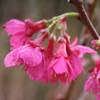
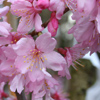
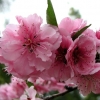
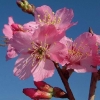
Here meanwhile everything is milder than it should be and wet wet wet, but the Taiwan cherries are in full flower and the Tuis and Silvereyes just zooming.
Really the trick is to get a succession of
nectar bearing and fruiting plants to give as wide a flowering season as
possible. But the natives are learning too. This year for the first time I've
seen Tui sipping from grapefruit flowers and from Kniphofia.
As with bees plant lots of flowers and they'll find you. Then there's rosemary and zinnias to bring the gold finches."


Hamamelis or winter flowering witch-hazel has stunningly fragrant spidery flowers borne in small clusters all the way up the stems. Hamamelis means 'together with fruit' which refers to its flowering at the same time that last seasons fruit are still on the bush. Interestingly witch-hazel was the plant used by early US colonists as water divining rods just as Hazel was in England. It has many medicinal uses, home remedies and beauty therapies have been made using this plant for centuries. It likes sun and good rich soil that will hold some moistness to keep it happy. We currently have Diane and Jalena in stock.
Mini Bougainvilleas These look great used as small powerpacked colour spots in the garden when grown as shrubs and also look stunning in containers on patios or decks. We have some new varieties in this mini range which are Ciata, Quite White, Pedro and Zulu but also have quite a few others in the range as well. These are looking gorgeous right now for a spot of brightness on a dull day.


There are two types of Rhubarb - evergreen and winter dormant. Winter dormant types down each winter and reappear when the soil warms in spring such as Grans Favourite. Then there are the evergreen varieties that produce good pickable stalk all year round. New to us varieties include Claret Cobbler and Ruddy fool. Other evergreen varieties also available are Crimson Crumble and Glaskins Perpetual.





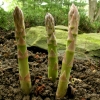
Asparagus To get quicker results from your asparagus it is best to get crowns as growing Asparagus from seed will take 2 to 3 years before you can harvest it. In the first year you shouldn't harvest any spears, just let the crowns grow the ferny foliage. The 2nd year you can harvest for half the time and then let it go into leaf. Then the 3rd year you can harvest the full season and then let go to leaf.
The best way to plant asparagus is to dig a trench of approx spade depth and width, add well rotted compost to approximately half the trench then add the soil back to form a ridge within the trench. Place your asparagus crowns at 45cm spacing, spreading the roots either side of the ridge, complete back filling the trench until the crowns are covered with about 7 cm of soil. Ensure that all is firmed back down and give a good watering. If you have multiple rows then these also need to be 45cm apart.
You may need to water them in summer if it is dry to ensure that the crowns don't dry out too much, cover with mulch for the winter months to protect and feed the crowns.
Harvest when the spears are thicker than a pencil width by cutting with a sharp blade just below the soil surface. Remember to keep up on the feeding as Asparagus like lots of food to do well. Asparagus can continue to provide for you for many years once established. I have also had white asparagus, perhaps the you can try to grow your own white asparagus, now there's a challenge!



The word is that we are supposed to be having a fine weekend this weekend except for a few showers Sat. morning so this could be a great weekend for getting the rose and fruit tree pruning finished if you haven't already. Whatever you end up doing have a great weekend!
Archived by year 2022 | 2021 | 2020 | 2019 | 2018 | 2017 | 2016 | 2015 | 2014 | 2013 | 2012 | 2011 | 2010 |
2016 Newsletters...
Picnic....ing in the shade (28th January, 2016)
Wairere Newsletter 5th feb (3rd February, 2016)
To Run or Not to Run... (19th February, 2016)
Wairere Newsletter 02 Mar (1st March, 2016)
Camellia time (11th March, 2016)
Magnolia or Michelia (17th March, 2016)
Easter weekend (24th March, 2016)
HW or LW Trees (3rd April, 2016)
Evergreen Trees (13th May, 2016)
All about shrubs (20th May, 2016)
Rose Time (27th May, 2016)
Frosty Friday (3rd June, 2016)
Tiny Camellias (9th June, 2016)
Gorgeous Trees (24th June, 2016)
wet wet wet (1st July, 2016)
Burgundy foliage (8th July, 2016)
Fruit trees abound (15th July, 2016)
Fruit Tree Pruning and Flowering Cherries (21st July, 2016)
Cider apples (29th July, 2016)
August already (4th August, 2016)
..... wood pigeons
Feed Time (19th August, 2016)
Magnolia's and Cider Apples (20th August, 2016)
its Official (2nd September, 2016)
Spring shrubs (7th September, 2016)
Spring Shrubs2 (7th September, 2016)
Spring Shrubs 2 (7th September, 2016)
Tricky Tasks (16th September, 2016)
climbers (23rd September, 2016)
Wairere Newsletter 23 Sep (23rd September, 2016)
Beards are in vogue (23rd September, 2016)
Gin Oclock (14th October, 2016)
????Kumaras are in (20th October, 2016)
summer is coming (27th October, 2016)
Plants for eating (2nd November, 2016)
November 11 (10th November, 2016)
Hamilton Gardens (17th November, 2016)
Xmas Trees (22nd November, 2016)
Holly (2nd December, 2016)
Xmas Brekkie (9th December, 2016)
Merry Xmas (16th December, 2016)
HL Nurseries Limited t/a Wairere Nursery
826 Gordonton Road, R D 1, Hamilton 3281 Ph: (07) 824 3430 Email: